
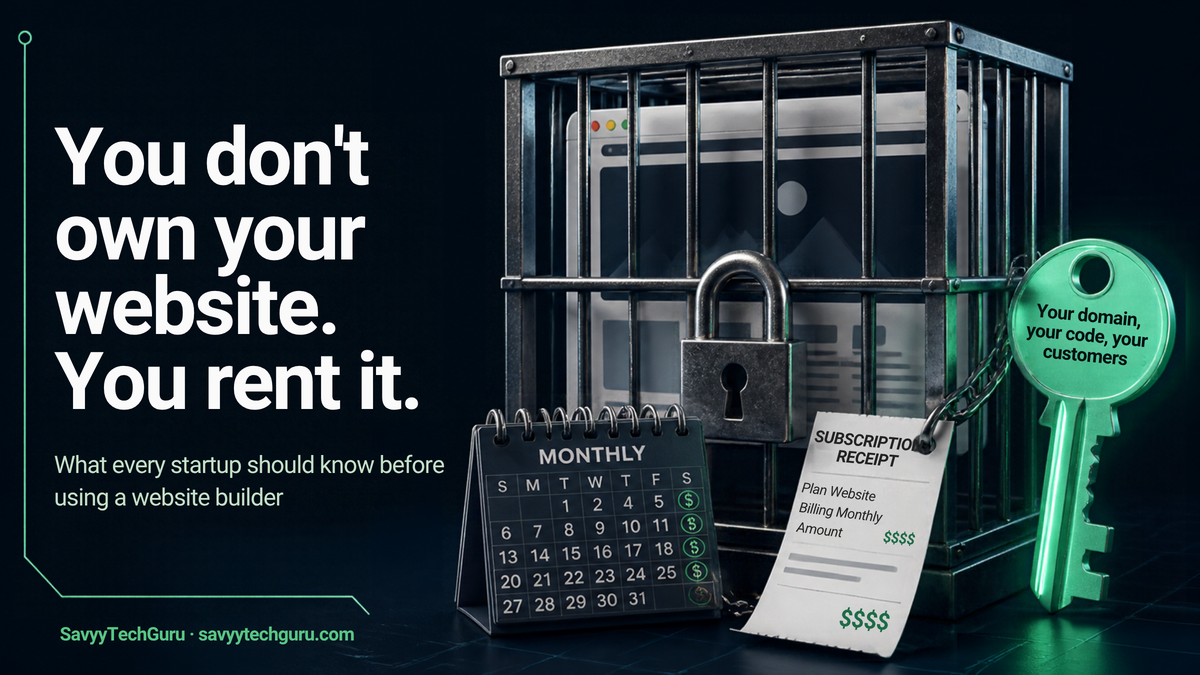
The quick start that becomes a long lease
When you start a business, a drag-and-drop website builder looks like the sensible choice. Pick a template, add your logo, pay a small monthly fee and you are online by the weekend. For a hobby or a test idea, that is often fine.
The problem starts when the business works. The website becomes the place customers find you, book you and judge you, and you realise it was never really yours. You have been renting it, on terms someone else sets, from a company that can change those terms whenever it likes.
This is not a rant against any one platform. Builders like Wix and Squarespace are well made and suit some people. But every startup owner should understand what they are signing up to before their business depends on it.
What you usually don't own on a website builder
1. The website itself
On most hosted builders you cannot take your finished website and move it to another host. The design, layout and code live on the platform. You can usually take your domain name with you, and sometimes export some text or blog posts, but the site you paid to build stays behind. If you want to leave, you rebuild from scratch.
2. Your right to stop paying
A builder is a subscription. Stop paying and the premium features go, and in most cases the site goes offline or reverts to a basic version with the platform's branding. There is no point where you have paid it off. Year five costs the same as year one, or more if prices rise at renewal.
3. The add-ons your business needs
The advertised price is rarely the real price. Online bookings, deposits, extra form features, business email, a store, removing the platform's branding, extra storage: these are often separate plans or paid apps, each with their own monthly fee. A £15 a month website quietly becomes £40, £60 or more.
4. The rules
The platform decides which features exist, how fast your pages load, what code you can add, how your pages are structured for Google and what happens when they change their pricing. When a feature you rely on is moved to a higher plan, your choice is to pay or to leave, and leaving means starting again.
5. Your template choices
On some builders, once your site is live you cannot simply switch to a different template. A rebrand or redesign two years in can mean rebuilding the site inside the same platform anyway.
6. Easy access to your own customer data
Bookings, form enquiries and contact lists often live inside the platform's own tools. Exporting them is sometimes possible but awkward, and connecting them to the CRM, accounts or AI tools you want to use later can mean yet more paid apps.
The three-year maths
As an example, take a startup on a builder plan at £25 a month, plus a booking app at £15 a month and business email at £6 a month. That is £46 a month, or about £1,656 over three years, and at the end you own nothing you can take with you. Prices vary by platform and plan, so put in your own numbers, but the shape is always the same: the cost never stops and the asset never becomes yours.
A website you own works the other way round. You pay to build it once, then pay modest hosting. After the build, the yearly cost is low, and if you ever fall out with your developer or your host, you move the whole site somewhere else.
"Lifetime" and "free website" deals: read the small print
Website builders are not the only tie-in. Watch out for:
- Agency monthly plans where the agency owns the site and the domain, and you only keep using it while you keep paying.
- "Free" websites bundled with directories, booking platforms or marketplaces, where the platform controls your listing, your reviews and sometimes your customers.
- Domains registered in someone else's name, often a developer or agency, so you cannot move without their help.
- Booking and marketplace platforms that take a commission per booking and own the customer relationship, so the customer remembers the platform, not you.
None of these is automatically a scam. They are trade-offs. The issue is that most owners never realise they made one.
When a website builder is the right choice
To be fair: if you are testing an idea, have no budget at all, or simply need a page with your phone number while you trade for the first few months, a builder is a reasonable place to start. Just treat it as temporary, register the domain yourself from day one, and plan the move before the business depends on it.
What to own from day one
Whoever builds your website, insist on these five things in writing:
- The domain registered in your name, with your own login.
- The hosting account in your name, or the right to move the site whenever you want.
- The website files and code handed over, so another developer could pick it up.
- Your Google Business Profile, Analytics and Search Console in your name, with the agency added as a user, not the owner.
- Your customer and booking data exportable in a normal format at any time.
If a provider will not agree to those, you are renting, whatever they call it.
How we build for startups
Every website we build at SavvyTechGuru is yours. The domain, hosting and accounts are set up in your name, and the site is built to bring enquiries rather than just exist: fast on a phone, set up for Google, with bookings, deposits, a simple editor and a CRM if you need them. You pay a fixed price for the build, and you can take it anywhere.
Starting a business in Coventry or Warwickshire?
Tell us what you're launching and we'll tell you straight whether you need a builder, a custom site or neither yet. Fixed prices, everything in your name.
See what's included → 📞 07870 565414Questions people ask
Can I move my Wix website to another host?
Generally no. You can transfer your domain name, but the website design itself stays on the platform, so moving away usually means rebuilding the site elsewhere.
Is Wix or Squarespace bad for SEO?
Not automatically. Both can rank. The limits are control and flexibility: you work within what the platform allows for page structure, speed and code, which matters more as you compete for local searches.
What happens to my website builder site if I stop paying?
On most builders the premium features stop and the site goes offline or reverts to a basic version with the platform's branding. There is no point at which you have paid it off.
Should a startup use a website builder?
It can be a sensible short-term option for testing an idea with no budget. Register the domain in your own name from day one and plan to move to a site you own before the business depends on it.
What should I own when someone builds my website?
The domain, the hosting account, the website files, your Google Business Profile and analytics accounts, and an export of your customer and booking data, all in your name.


